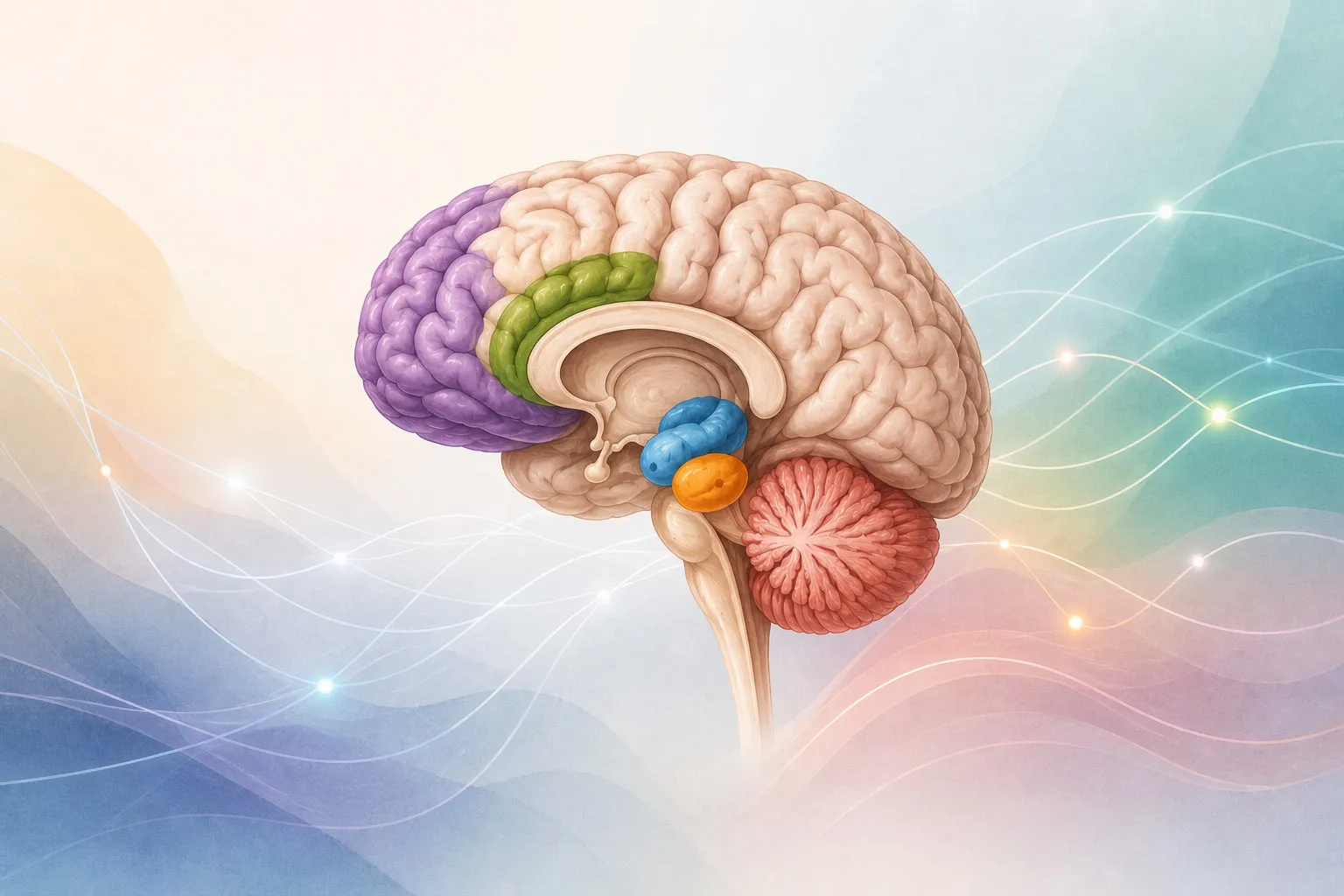

If you have started EMDR therapy, or you are considering whether it might help with something you have been carrying, it is natural to wonder what is actually happening in your brain when it works. EMDR can feel unusual at first. The eye movements, the focus on a specific memory, the way distress sometimes shifts within a single session. Many people describe it as both surprising and quietly powerful, and they often want to understand the science behind it.
This guide explores the current research on the neurobiology of EMDR. It looks at how trauma may be stored in the brain, what neuroimaging studies suggest changes during and after EMDR therapy, and the leading theories about why it might work. Throughout, we will be careful to distinguish what the evidence currently supports from what remains an open question, because both matter.
EMDR (Eye Movement Desensitisation and Reprocessing) is recognised as an evidence-based therapy for post-traumatic stress disorder by the World Health Organization, the Australian Psychological Society, and the Australian Guidelines for the Prevention and Treatment of PTSD published by Phoenix Australia. The therapy was developed by Dr Francine Shapiro in the late 1980s and has been the subject of growing neuroscience research over the past two decades. While many questions remain, the research base offers genuinely interesting clues about how the brain processes traumatic memory and how EMDR may support that process.
How trauma may affect the brain
To understand what EMDR may do in the brain, it helps to first consider what trauma appears to do. While every person’s experience is different, neuroscience research has identified several brain regions that seem to be particularly involved in how traumatic memories are stored and how post-traumatic symptoms are maintained.
The amygdala: the brain’s threat detector
The amygdala is a small almond-shaped structure deep in the temporal lobes that plays a central role in detecting threat and triggering protective responses. In people with PTSD, neuroimaging studies consistently show the amygdala becomes hyperactive, responding strongly not only to genuinely threatening situations but also to reminders of past trauma. Research published in Biological Psychiatry and other journals has documented this pattern across many studies.
This hyperactivation may help explain some of the most distressing features of PTSD, including the sense of being constantly on edge, the intensity of flashbacks, and the way ordinary cues such as a sound, a smell, or a particular tone of voice can trigger an overwhelming stress response.
The hippocampus: memory in context
The hippocampus, also located in the temporal lobes, is essential for placing memories in their proper context, including the where and when of an experience. It helps the brain distinguish between past and present, allowing us to remember a difficult event without feeling that it is happening again right now.
Studies of people with PTSD have found, on average, smaller hippocampal volumes compared with non-traumatised controls, although individual variation is significant. Disrupted hippocampal function is thought to contribute to the fragmented, timeless quality of traumatic memory, which can feel less like remembering and more like reliving.
The prefrontal cortex: top-down regulation
The prefrontal cortex, particularly the medial prefrontal cortex, plays an important role in regulating emotional responses generated by the amygdala. You can think of it as a kind of brake or modulator for the threat system, helping the brain reassess situations and respond proportionally.
In PTSD, neuroimaging research suggests that the medial prefrontal cortex tends to be underactive, particularly when trauma reminders arise. The result is a brain in which the alarm system is amplified while the regulating system is dampened, a configuration that may help explain why distress can feel so difficult to manage from the inside.
The thalamus: sensory relay (new)
The thalamus is a deep central structure that acts as a relay station for sensory and cognitive information, routing incoming signals to the amygdala and cortex before conscious processing occurs. In the context of trauma, disrupted thalamic function may contribute to the fragmented, unintegrated quality of traumatic memory — with sensory, emotional, and cognitive elements remaining poorly connected.
Bergmann has proposed that bilateral stimulation in EMDR may act partly through the thalamus, helping to re-bind fragmented memory traces with their associated sensory and emotional information. This is consistent with the broader large-scale network models of EMDR’s mechanism discussed below.
The insula: body awareness and internal signals (new)
The insula plays an important role in body awareness, interoception (the brain’s monitoring of internal bodily states), and emotional experience. In trauma, the insula’s capacity to accurately read and interpret bodily signals can be disrupted, contributing to both the heightened physical reactivity common in PTSD and, in some people, a disconnection from bodily experience altogether.
EMDR’s emphasis on noticing body sensations during processing — and the structured return to present-moment awareness supported by bilateral stimulation — may support greater integration of bodily and emotional experience via insular pathways. This aligns with clinical observations that people often report increased body awareness and a calmer physical sense of self following effective EMDR treatment.
When memory becomes “stuck”
In Shapiro’s Adaptive Information Processing model, traumatic memory is understood as information that has not been fully processed. Rather than being integrated into a coherent narrative alongside other life experiences, it appears to remain stored in a more raw, sensory, emotionally charged form. The original sights, sounds, body sensations, and beliefs can stay linked together in ways that make the memory easy to trigger and difficult to settle.
This is sometimes described as the memory being “stuck” in the limbic system rather than fully connected with the prefrontal regions that would normally provide perspective and context. Whether or not we accept this exact metaphor, something like it is consistent with the broader pattern researchers observe in traumatic memory.
The Adaptive Information Processing model
The Adaptive Information Processing (AIP) model is the foundational theory underpinning EMDR therapy. Proposed by Shapiro in her 1995 textbook and refined since, the AIP model proposes that the brain has an innate capacity to process and integrate distressing experiences, much as the body has an innate capacity to heal a physical wound.
When this processing system functions well, difficult experiences are gradually metabolised. The emotional charge fades, useful lessons are retained, and the memory takes its place among other autobiographical memories. When the processing system is overwhelmed, by intensity, duration, or developmental timing, the memory can remain in an unprocessed state, continuing to influence how the person feels and responds in the present.
EMDR, according to the AIP model, aims to reactivate this natural processing system, allowing memories that have remained stuck to be integrated more adaptively. This is sometimes described in clinical settings as helping the memory move from being an intrusion in the present to being something that genuinely happened in the past.
The AIP model is a clinical framework rather than a fully validated neurobiological mechanism, and researchers continue to investigate exactly how this process unfolds in the brain. What follows are the leading theories.
Leading theories of how EMDR may work in the brain
There is no single agreed-upon mechanism for EMDR. Instead, several theories have been proposed, each with its own evidence base and limitations. A 2018 systematic review published in Frontiers in Psychology by Landin-Romero and colleagues, including researchers from the University of Sydney’s Brain and Mind Centre, examined the evidence for each major theory and concluded that several are plausible and that they are not necessarily mutually exclusive.
Working memory taxation
Currently the best-supported analogue model, the working memory hypothesis was proposed by Andrade, Kavanagh and Baddeley in 1997 and developed substantially by van den Hout, Engelhard, and colleagues.
The idea is that working memory, the brain’s short-term workspace, has a limited capacity. When a person holds a vivid traumatic memory in mind while simultaneously performing a demanding task such as tracking a moving target with the eyes, the two activities compete for the same working memory resources. The memory tends to become less vivid and less emotionally intense as a result. When the memory is later restored to long-term storage, it returns in this slightly altered, less distressing form.
A 2012 review in the Journal of Experimental Psychopathology summarises the laboratory evidence, including studies showing that the effect is not unique to eye movements. Other tasks that tax working memory, including counting backwards, drawing complex shapes, or playing demanding video games, produce similar reductions in memory vividness. This is an important nuance: it suggests the eye movements themselves may not be the active ingredient so much as the working memory load they impose.
Memory reconsolidation
A second and increasingly influential theory draws on the concept of memory reconsolidation, established in animal research by Nader, Schafe, and LeDoux in 2000. This research showed that when a previously consolidated memory is reactivated, it briefly enters a labile, modifiable state before being restored.
Within this reconsolidation window, which appears to last several hours, the memory can be updated by new information. If new emotional or sensory information that genuinely contradicts the original learning is introduced during this window, the memory may be permanently changed rather than simply suppressed.
EMDR may exploit this window. By bringing a traumatic memory to mind (reactivation), introducing dual-attention bilateral stimulation (a novel pattern of input), and pairing this with the felt experience of present safety (the therapy room, the regulated presence of the therapist), the conditions for memory updating may be created. Bruce Ecker and colleagues have argued that reconsolidation is a unifying mechanism across several effective trauma therapies, including EMDR.
REM sleep and slow-wave sleep
Robert Stickgold of Harvard Medical School proposed in a 2002 paper that the repetitive saccadic eye movements in EMDR may activate brainstem mechanisms similar to those active during REM sleep, a state in which the brain is known to consolidate emotional memories.
A more recent extension of this idea, developed by Pagani, Amann, Landin-Romero and Carletto in 2017, notes that the bilateral stimulation frequency commonly used in EMDR (around one to two cycles per second) overlaps with the slow-wave sleep delta-band frequency. Slow-wave sleep is associated with the consolidation of declarative memories and the transfer of memory traces from temporary hippocampal storage to longer-term cortical storage. The hypothesis is that EMDR may engage similar processes while the person is awake.
This remains an interesting theoretical model rather than a fully validated mechanism. The frequency overlap is suggestive, but the brain states involved in EMDR and in slow-wave sleep are clearly not identical.
The orienting response
A simpler and older theory, dating back to Pavlov, holds that bilateral stimulation triggers an orienting or investigatory reflex, the brain’s automatic “what is that?” response to a new stimulus. When the brain repeatedly orients to a stimulus that turns out to be harmless, a relaxation response follows. Some researchers, including Barrowcliff and colleagues, have proposed that this de-arousal response, paired with the trauma memory, may help reduce the conditioned anxiety associated with that memory.
Skin-conductance studies and heart-rate measures during EMDR sessions have provided some support for an orienting and de-arousal pattern, although it is unlikely to be the whole story.
Thalamic and large-scale network models
More recent neuroscience has begun to look beyond individual brain regions to consider how EMDR may affect large-scale brain networks. The thalamus, a deep central structure that acts as a relay station for sensory and cognitive information, has been proposed by Bergmann as a key site where EMDR’s bilateral stimulation may help re-bind fragmented memory traces with their associated sensory and emotional information.
The triple network model, drawing on the work of Vinod Menon, considers EMDR through the lens of three large-scale brain networks: the Default Mode Network (involved in autobiographical memory and self-referential thought), the Salience Network (which detects what is important and switches between other networks), and the Central Executive Network (which directs goal-focused attention). PTSD is associated with characteristic dysregulation across these networks, and a 2013 study by Landin-Romero and colleagues found that EMDR was associated with normalisation of Default Mode Network connectivity.
A note on the older “left-right brain” idea
Earlier popular explanations of EMDR often invoked the idea that bilateral stimulation works by promoting communication between the left and right hemispheres of the brain. This explanation has not held up well to scrutiny.
Research has shown that vertical eye movements, which do not alternate between hemispheres in the same way, produce comparable effects to horizontal eye movements. Gunter and Bodner’s 2008 work and several subsequent studies make the strict interhemispheric communication theory difficult to sustain. Current thinking has largely moved on from this model, although it remains widely cited in older popular sources.
What neuroimaging studies show
Neuroimaging research using fMRI, EEG, and other techniques has begun to map what changes in the brain before, during, and after EMDR therapy. The findings are encouraging but should be interpreted with appropriate caution given small sample sizes and methodological variability.
EEG findings
Pagani and colleagues, in a 2012 study published in PLOS ONE, used EEG to monitor brain activity during EMDR sessions in real time. Across the course of treatment, they observed a shift in the location of peak cortical activation: from limbic and orbitofrontal regions early in treatment, where emotional and threat-related processing dominates, toward temporo-occipital regions later in treatment, after symptom remission, suggesting a shift toward more cortical, integrated processing of the same memory material.
This pattern has been replicated in subsequent studies and is one of the most consistent neuroimaging findings in the EMDR literature.
fMRI findings
Functional MRI studies have generally found reduced amygdala activation and increased prefrontal cortex activation following EMDR therapy. A 2016 pilot study by Thomaes, Engelhard and colleagues examined what happens when people perform eye movements while recalling distressing memories, and found patterns consistent with the working memory hypothesis. A 2017 study by Boukezzi and colleagues examined changes in fear extinction learning after EMDR and found modified involvement of the amygdala, prefrontal cortex, and left hippocampus.
Hippocampal volume
A small number of studies have reported increases in hippocampal volume following EMDR therapy. Bossini and colleagues in 2011 reported bilateral hippocampal volume increases in PTSD patients after EMDR. These findings are intriguing but require replication in larger samples before strong conclusions can be drawn.
Default Mode Network
The Default Mode Network is a set of brain regions that are active when a person is at rest, mind-wandering, or engaged in self-referential thought. PTSD is associated with disturbed connectivity within this network. Research suggests that successful EMDR therapy may be associated with normalisation of Default Mode Network function, which is consistent with the clinical observation that people often report feeling more themselves after effective trauma therapy.
How to interpret the imaging research
It is worth holding these findings carefully. Sample sizes in many EMDR neuroimaging studies are small, methodologies vary, and replication is still ongoing. The picture that emerges is consistent and plausible, suggesting that EMDR is associated with measurable shifts in brain activity in regions known to be involved in trauma processing. However, neuroimaging research does not prove that any single mechanism is operating, and the brain changes observed are correlational. They tell us something is happening; they do not yet tell us, with full clarity, exactly what or why.
The role of bilateral stimulation
Bilateral stimulation is the rhythmic, alternating sensory input used during the desensitisation phases of EMDR. It is most commonly delivered as side-to-side eye movements, although alternating taps on the hands or knees, and alternating auditory tones delivered through headphones, are also used. These different forms appear to produce comparable clinical effects, which is itself an important clue about the mechanism.
If eye movements specifically were essential, alternative forms of bilateral stimulation should not work as well. The fact that they do suggests the active ingredient is something more general than the eye movements themselves, most likely the working memory load created by attending simultaneously to the memory and to the rhythmic stimulus.
One theory suggests bilateral stimulation may work by taxing working memory, which may reduce the vividness and emotional intensity of traumatic memories during processing. This is currently the best-supported laboratory model, though it is unlikely to be the only mechanism at work.
The clinical experience of bilateral stimulation also hints at why it may matter. Most people describe the experience as creating a kind of dual awareness, in which the memory remains accessible while the present moment, including the safety of the therapy room, also stays in focus. This dual awareness is considered important by many EMDR clinicians and is consistent with the broader trauma therapy principle that processing happens best when a person is engaged with the memory but not overwhelmed by it.
EMDR and the autonomic nervous system: a polyvagal perspective
EMDR’s effects are not limited to cortical brain regions. The autonomic nervous system, which regulates heart rate, breathing, digestion, and arousal, also appears to be involved. This is where polyvagal theory offers a useful complementary lens.
Studies that have measured heart rate variability and skin conductance during EMDR sessions have generally found shifts toward parasympathetic engagement during effective processing, suggestive of vagal involvement. Sack and colleagues, and Elofsson and colleagues, have reported autonomic shifts during bilateral stimulation that are consistent with parasympathetic activation, although the findings are not entirely uniform across studies.
From a polyvagal perspective, this may matter for several reasons. Effective trauma processing appears to require what is sometimes called dual awareness, the capacity to access a difficult memory while remaining anchored in the felt experience of present safety. This dual awareness depends on ventral vagal engagement, the autonomic state associated with safety and social connection. EMDR’s preparation phase, with its emphasis on resourcing and stabilisation, can be understood in part as building this autonomic foundation before processing begins. The bilateral stimulation, the regulated presence of the therapist, and the structured nature of the protocol may all contribute to maintaining ventral vagal engagement during processing.
This is an area where the clinical wisdom of EMDR practitioners and the theoretical framework of polyvagal theory appear to align well, even where the formal research is still developing. For practical approaches to nervous system regulation, our polyvagal exercises guide offers a starting point.
What the research shows and what remains uncertain
It is worth being honest about both what the research has established and what is still being worked out, because both matter for understanding EMDR fairly.
What the evidence supports reasonably well:
EMDR is associated with significant reductions in PTSD symptoms in many people, comparable in efficacy to trauma-focused cognitive behavioural therapy. This conclusion is reflected in major systematic reviews and is the basis for EMDR’s recognition by the WHO, the APA, and the Phoenix Australia Guidelines.
EMDR is associated with measurable changes in brain activity, particularly in the amygdala, prefrontal cortex, hippocampus, thalamus, and insula, in directions that are consistent with reduced threat reactivity, improved top-down regulation, and greater integration of bodily and emotional experience.
The working memory hypothesis has substantial laboratory support and currently provides the best account of why bilateral stimulation, regardless of its specific form, may help reduce the vividness and emotionality of distressing memories.
What remains less certain:
Whether the eye movements themselves are essential, or whether they are simply one of many ways to create the working memory load that appears to be the active ingredient. Some meta-analytic work by Lee and Cuijpers has found that adding eye movements to standard exposure-based treatment produces a modest additional benefit, while other research has been more mixed.
Whether changes in hippocampal volume or large-scale network connectivity are reliable findings or artefacts of small samples and specific methods. Replication in larger studies will help clarify this.
Whether the proposed mechanisms (working memory taxation, memory reconsolidation, REM-like processing, orienting response, network normalisation) are best understood as competing theories or as overlapping descriptions of the same underlying process. Most current researchers favour the latter view, but this remains an open question.
What this means for the average reader is that EMDR is a therapy with strong evidence for its clinical effects and growing but still incomplete evidence for the specific mechanisms by which it produces those effects. This is not unusual in psychotherapy research: many effective treatments are better understood at the outcome level than at the mechanistic level.
EMDR in the Australian context
In Australia, EMDR is recognised as a recommended treatment for PTSD by the Phoenix Australia Australian Guidelines for the Prevention and Treatment of Acute Stress Disorder, PTSD and Complex PTSD, which are endorsed by the National Health and Medical Research Council. The Australian Psychological Society rates EMDR as having Level I evidence for PTSD, depression, specific phobias, and complex PTSD, and Level II evidence for substance use disorders.
EMDR is included as one of the Focussed Psychological Strategies under the Medicare Better Access Scheme, meaning sessions delivered by appropriately registered psychologists may be eligible for Medicare rebates when provided under a Mental Health Care Plan from a GP.
Practitioners in Australia who have completed comprehensive EMDR training and met additional standards can apply for accreditation through the EMDR Association of Australia (EMDRAA), the Australian peak body for EMDR. EMDRAA accreditation is a voluntary credential beyond AHPRA registration, and indicates that the practitioner has met specific standards of training, supervision, and ongoing professional development in EMDR. The EMDRAA Find a Therapist directory can be helpful when seeking an accredited practitioner.
Working with a therapist
While understanding the neurobiology of EMDR can be genuinely helpful, the therapy itself is best undertaken with a qualified practitioner who can tailor the approach to your individual history, current circumstances, and nervous system. EMDR is structured but not formulaic. The preparation phase in particular varies considerably depending on what each person needs in order to feel safe enough to begin processing.
When considering EMDR, it can be useful to ask:
- Is the practitioner registered with AHPRA?
- Have they completed comprehensive EMDR training, and if so, with which training organisation?
- Are they accredited with EMDRAA, or working toward accreditation?
- How do they approach preparation and stabilisation before processing memories?
- How do they integrate EMDR with other trauma-informed approaches, such as polyvagal-informed therapy or somatic work?
There is no single right answer to most of these questions, but a clear, considered response is generally a good sign.
Frequently asked questions
Does EMDR rewire the brain?
The phrase “rewire the brain” is often used in popular descriptions of EMDR, but it overstates what the research currently shows. What the evidence does suggest is that EMDR is associated with measurable changes in brain activity, particularly in regions involved in threat detection and emotional regulation, and that these changes appear to support the integration of traumatic memories. Whether this counts as “rewiring” depends on how strictly the term is used.
What part of the brain does EMDR target?
EMDR does not target a single brain region. Research suggests it is associated with changes across several regions and networks, including the amygdala (often less reactive after treatment), the medial prefrontal cortex (often more engaged), the hippocampus (in some studies, increased volume), the thalamus (involved in routing and integrating sensory information), the insula (involved in body awareness and internal signals), and the Default Mode Network (often more regulated).
Is EMDR scientifically proven?
EMDR is recognised as an evidence-based treatment for PTSD by the WHO, the APA, and the Phoenix Australia Guidelines. The clinical evidence for its effectiveness in treating PTSD is strong. The exact mechanisms by which it works are less settled, although several plausible theories are supported by laboratory and neuroimaging research.
Why do eye movements help?
One theory suggests that eye movements may help primarily because they tax working memory, the brain’s short-term cognitive workspace. This may make traumatic memories temporarily less vivid and less emotionally intense, allowing them to be reconsolidated in a less distressing form. Other working memory tasks can produce similar effects, which suggests the eye movements themselves are not uniquely required.
Does EMDR work like REM sleep?
This is one of several theories. The repetitive eye movements in EMDR, and the slow-wave-like frequency of bilateral stimulation, have led some researchers to propose that EMDR may engage memory processing mechanisms similar to those active during sleep. The hypothesis is interesting, but EMDR and sleep involve clearly different brain states overall, and the analogy should not be taken too literally.
How long does it take to see brain-level changes?
In neuroimaging studies, measurable changes in brain activity have been observed after just a few EMDR sessions in some cases, with more substantial changes following a complete course of treatment. Clinically, the pace of change varies considerably from person to person and depends on the complexity of the trauma history, the person’s current circumstances, and many other factors.
Why is EMDR sometimes described as controversial?
Earlier in its history, EMDR was met with scepticism within parts of the research community, partly because of the unusual nature of its eye movement component and partly because the mechanism was unclear. The clinical evidence for its effectiveness has accumulated to the point where most major guidelines, including those in Australia, now recommend it for PTSD. Debate continues about the precise mechanism and the role of eye movements specifically, but the therapy itself is no longer particularly controversial in mainstream trauma research.
How does EMDR compare to CBT?
EMDR and trauma-focused cognitive behavioural therapy (TF-CBT) appear to have broadly comparable effectiveness for PTSD across most studies. They differ in approach: TF-CBT typically involves detailed verbal processing of the trauma narrative, while EMDR uses bilateral stimulation while the person holds the memory in mind, with less emphasis on detailed verbal recounting. For some people, this difference matters, although there is no strong evidence that one is broadly superior to the other.
Conclusion
The neurobiology of EMDR is an active and evolving area of research. What the evidence currently suggests is a coherent picture: EMDR engages the brain’s natural memory processing systems, taxes working memory in ways that may reduce the vividness and emotional charge of traumatic memories, supports the reconsolidation of those memories in a less distressing form, and appears to be associated with measurable shifts in brain activity in regions involved in threat detection and emotional regulation — including the amygdala, prefrontal cortex, hippocampus, thalamus, and insula.
What the evidence does not yet do, and may never do completely, is provide a single, simple mechanism for how EMDR works. This is partly because trauma is itself complex, partly because the brain is exquisitely interconnected, and partly because effective therapy almost certainly works through several routes at once.
For someone considering EMDR, or already in the middle of it, the science can be reassuring without needing to be definitive. There is good reason to think the therapy works through plausible biological mechanisms, supported by a growing body of neuroimaging research, and consistent with what we are learning about how the brain processes traumatic memory more broadly. The remaining uncertainties are real, but they are the kind of uncertainties that come with a developing field, not signs that something is wrong.
If the ideas in this article have raised questions about your own experience, those questions may be worth exploring with a qualified mental health professional. EMDR is one of several evidence-based options for trauma therapy in Australia, and a good practitioner can help you decide whether it is the right approach for you.
If you are experiencing distress, support is available. Lifeline Australia (13 11 14) offers 24-hour crisis support. Beyond Blue (1300 22 4636) offers anxiety and depression support. 1800RESPECT (1800 737 732) offers support for sexual assault and family violence. 13YARN (13 92 76) offers culturally safe crisis support for Aboriginal and Torres Strait Islander peoples.